Fryeburg Fair Ghost House
Bag of BonesThe Fryeburg Fair Ghost House is a carnival attraction that, during Mike’s flight with Kyra, opens onto a passage between times. Its familiar attractions briefly transform a pursuit by the dead into a child’s game, but the building’s impossible scale and three symbolic doors reveal that it is more than a fairground funhouse: it is a threshold to places where the ordinary rules of space and time no longer hold.
Entry Under Pursuit
Mike reaches the Ghost House carrying Kyra in his arms, fleeing a crowd of dead figures that has reached out toward them. More ghosts emerge from broken windows and brick chimneys as he runs. The threat follows to the attraction’s entrance, where Jared Devore calls after Mike and claims that Kyra is not his child. The people pursuing them crowd the steps, but the ticket seller blocks the demand to stop him with a practical warning: the attraction is for children, and anyone who breaks it will have to pay.
Inside, the passage is narrow enough that Mike must turn sideways. Phosphorescent eyes show in the gloom, while a wooden rumble and clacking chain signal an obstacle ahead. The pursuers’ heavy boots thunder up the steps behind them, but the ticket seller’s resistance buys the pair a moment to get farther in. The sequence shifts the Ghost House from a place where visitors pay for manufactured scares into a refuge whose ordinary rules of admission and property unexpectedly impede the dead.
The Funhouse as Refuge
Kyra asks to be put down so she can cross the rolling barrel by herself. Mike lets her go, though the entrance behind them is being blocked as their pursuers try to force their way inside. Kyra makes it across laughing; Mike falls and tumbles through, losing a bandanna and a bag of horehound candy from his pockets. The funhouse’s physical comedy interrupts the chase without making its danger disappear: Mike still listens for the pursuers as he struggles to keep moving.
Farther along, a burst of steam frightens Kyra at first, but when the hiss comes again she laughs instead. In a mirrored corridor, their reflections change into distorted shapes, and Kyra wants to stop to make faces at herself. A sliding pole drops them onto a canvas pillow that makes a comic noise when they land. These attractions redirect her from fear to play, while Mike repeatedly urges her onward. Her growing confidence is visible in the reversal: she begins as the child he carries and ends up leading him by the hand.
The Ghost House’s workers are not supernatural: behind a wall, two costumed ghosts mechanically rattle chains and talk about their plans for the night. The mundane conversation sits alongside the real pursuit outside, making the attraction’s staged haunting a contrast to the dead men following Mike and Kyra. At a door marked as the way to Hades, Kyra pushes ahead without hesitation, while the red-tinted light above the passage gives the supposed underworld an unexpectedly pleasant cast.
The Impossible Scale and the Doors
The route through the building feels extraordinarily long. Mike realizes that they can no longer hear the fair’s calliope, the strength-test bell, or Sara and the Red-Tops, and estimates that they may have walked a quarter of a mile. The distance exceeds what he can accept as an ordinary county-fair attraction. The Ghost House has not simply hidden them from the pursuers; it has carried them away from the sounds and measures of the fairground itself.
At the end of the passage stand three doors. The left-hand door bears a red tricycle; the door opposite it is painted with Mike’s green IBM typewriter; and the door at the end shows a child’s sled. Mike recognizes the sled as Scooter Larribee’s, the one he thinks Devore stole. Kyra calls the doors their toys and lifts Strickland so he can see the tricycle. The child’s casual reading of the images contrasts with Mike’s uneasy recognition: the doors are not interchangeable decorations but signs tied to particular objects and histories.
Kyra thanks Mike for taking her away from the frightening men, says that the spooky house was fun, and goes through the tricycle door. It shuts behind her. The ribbon from her hat remains in the bib pocket of Mike’s overalls, but the door will not open again; when he strikes it, its surface feels as hard as dense metal. The Ghost House has provided a way out for Kyra, not a route Mike can simply retrace to follow her.
The Between-Time
After Kyra’s door closes, Mike finds only silence behind him. He understands the place as the between-time: the gap people mean when they speak of slipping through the cracks, a destination rather than a figure of speech. The fairground attraction has become a liminal space in which its rooms, distances, and exits no longer obey ordinary expectations.
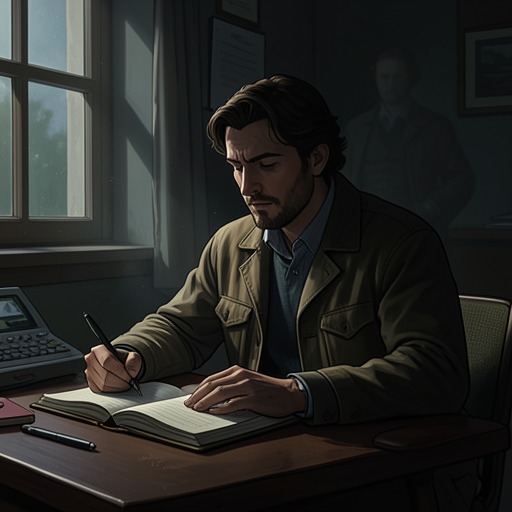
Mike turns to the door painted with his typewriter. Its knob turns easily, opening onto another narrow corridor with wooden walls and the smell of pine. He hesitates because the passage reminds him of a coffin, but with no other way to go he enters, and the door shuts behind him. The image of the typewriter marks a distinct route from Kyra’s tricycle door, carrying Mike onward rather than returning him to the fair.
In the enclosed darkness, Mike expects one of his panic attacks, yet remains in control. He can see the plank floor and walls, and wraps the dark blue ribbon from Kyra’s hat around his wrist so it will not come loose before moving forward. The Ghost House therefore ends this passage not with a completed escape but with Mike alone at another threshold, carrying a small, tangible link to the child who has gone through a different door. Its narrative force lies in that split: the same attraction that offers Kyra a playful passage onward leaves Mike to continue through the uncanny space by himself.